Thursday, April 8, 2010

Martin Brothers

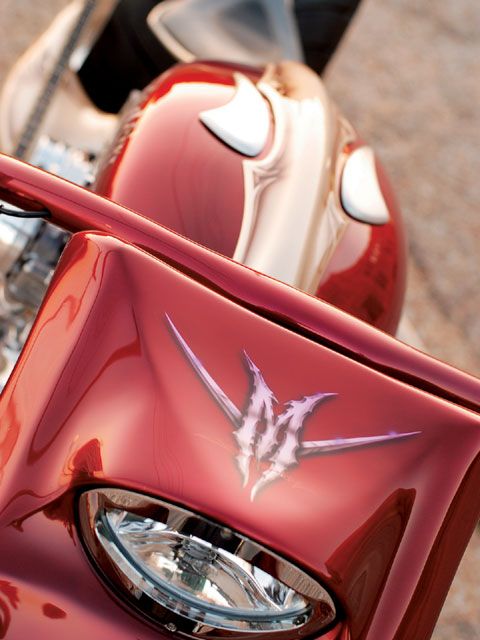
Bike: "Godsin"

Spec Sheet
GENERAL
SHOP NAME Martin Bros Bikes
SHOP PHONE (972) 709-2552
SHOP WEBSITE www.martinbrosbikes.com
YEAR/MAKE/MODEL '07/Custom
FABRICATION Joe Martin and Friends
ASSEMBLY Joe and Friends
BUILD TIME Six months

ENGINE
YEAR/ MANUFACTURER '07/Enginuity
TYPE/SIZE Evo/120ci
BUILDER Enginuity
CASES Enginuity
CYLINDERS Enginuity
HEADS Enginuity
ROCKER BOXES Enginuity
CARBURETOR S&S
AIR CLEANER Velocity Stack
EXHAUST Joe Martin

TRANSMISSION
YEAR/MANUFACTURER/TYPE '07/Baker/Torque Box
CASE Baker Drivetrain
CLUTCH PM
PRIMARY DRIVE PM

FRAME
YEAR/MANUFACTURER Joe Martin
RAKE 47 degrees
STRETCH Forgot

SUSPENSION
MANUFACTURER FRONT Pro-One
LENGTH 2 inches under
TRIPLE TREES Pro-One

WHEELS, TIRES, AND BRAKES
MANUFACTURER FRONT/TYPE Xtreme Machine/Billet
SIZE-HEIGHT/WIDTH 23 inches
TIRE/SIZE Avon/23
CALIPER PM
ROTOR Xtreme Machine
MANUFACTURER REAR/TYPE Xtreme Machine/Billet
SIZE-HEIGHT/WIDTH 20 inches/10.5
TIRE/SIZE Avon/20x280

FINISH/PAINT
COLOR Candy Brandywine
PAINTER Joe Martin
GRAPHICS Joe Martin
PLATING/POLISHING Advanced Plating

ACCESSORIES
GAS TANK&CAP Joe Martin
OIL TANK Joe Martin
HANDLEBARS Joe Martin
HAND CONTROLS PM
FOOT CONTROLS PM
FOOTPEGS PM
HEADLIGHT Kodlin
TAILLIGHT Kodlin
LICENSE MOUNT Kodlin
SEAT Joe Martin/Craig Ward

Yamaha Lovers...this is for you.

xs 650 in Montreal

xs 650 with extras

xs 400

xs 650 chopped and stretched

xs 650 Bobber

1977 xs 650 Hard tail

Tuesday, April 6, 2010

Pipes come in all Shapes and Sizes.


Your exhaust can sure change the look of the ride...this can be a great way to break away from the factory look. Be sure to check the specs cause it can also change the ride itself. Not every exhaust will work with your particular bike. Be sure to do your homework before making your purchase.
Also, Be sure to check your province or states regulations as you make changes like these. Most "loud pipe" fines start at $300 and $350!

Standing out in the Crowd.


Written by Rod

Over the last few years my bike has seen a fair few changes, some have been good, some down right bad. The bad ones were mainly from listening to guys that never thought further than the “Motor Co” square. Not that there is anything wrong with that but when I think of a custom Harley, I think of a bike that stands out from the pack, rather then one that blends into a mass of factory chrome and other factory accessories.

This latest customization has to be the best by far, the 200 tyre and paint job. The other mod that really impressed me 18 months ago was the 95 cube kit and the flowed “Rocket Heads” designed by Rick. Coupled with a 42mm Mikuni carby made all the difference in the power and torque gain. Back to the 200 tyre, I know what some of you might be saying, why don’t you buy a ’06 Standard with the 200 tyre already fitted? It comes back to a bike standing out from the pack thing again. I wanted something that the guard and wheel looked like it is a feature of the bike, not just another 200 tyre Softail Standard with an over sized factory guard.

I knew roughly what I wanted as far as a rear guard and wheels went but Rick gave me advice on both in the end. Rick also recommended using the LED rear tail light and indicators all combined in one unit as well. Roscoe set the 18”x 5.5” PM wheel and 200 Metzler tyre up in the standard swing arm after Rick machined the rear belt pulley down on the lathe to fit the 20mm belt. Rick then did the work on the rear guard, recessing the light fixture and profiling the guard. He also had to modify the struts for the guard as well. Rick had a Milwaukee Iron front guard that he was going to use on “Alien” but changed to another style so needless to say I jumped at getting that guard on my bike.

Rick organized to have the bike’s tin ware spray painted by Craig from Custom Spray Painting Concepts from the Sunshine Coast and Perry from Mallet Custom Art did the Artwork. Those boys really know their business.

By the way, the bike handles well with the 200 tyre. A slight change to my riding technique and I can honestly say it feels much more stable and positive in the back end under hard acceleration out of a 2nd or third gear corner.

There are a few good used Softail Standards getting around now at a reasonable price. This type of bike is a great base for a custom bike. Drop in and have a chat to Rick and the boys for some ideas. They will be more than happy to help.

Needless to say I couldn’t be happier with the results of my bike.

*Rick is from Gold Coast Choppers.

Thursday, April 1, 2010

Waiting isn't an option!

Extend your riding season: Cold weather strategies
By Bill Andrews

Here are some strategies for dealing with problem driving:
Black ice — really just an ominous name for hard-to-see frozen water on the road — can occur any time the temperature has been near the freezing point, or where frost can form. Some touring bikes have an air-temperature thermometer, but adding one to any bike is a cheap fix.
Bridges are susceptible to icing because they are disconnected from the warmth of the Earth and cool faster when air temperatures drop. Watch for spots on the road that are shaded from the sun. Well-traveled roads are often better, because passing traffic melts and dries the moisture.
If you do feel like you're on an icy patch, don't make any sudden moves, and don't touch the brakes. Pull in the clutch and let the bike coast until you're clear.
Hypothermia
That cold shiver up your spine isn't just uncomfortable. It could also be a warning.
Hypothermia occurs when your core body temperature drops significantly, and it can be deadly.
Temperatures don't need to be below freezing to induce hypothermia. Wind chill gets worse as wind speeds increase, and the longer you're out, the worse it gets.
One early sign of potential hypothermia occurs when you start feeling cold and you can't decide if you should pull over or not. The answer is always yes, but your judgment may be clouded. Long before this point occurs, you should have pulled into that nice warm cafe and had some hot chocolate or soup.
Uncontrolled shivering and chattering teeth are signs of real danger. You may start to feel dizzy, or even drunk, as your muscles begin to stiffen. Continued exposure may cause the shivering to slow down or even stop, but by then you're in serious trouble.
The well-dressed rider
How do you mitigate the dangers of cold weather? First of all, cover up.

It all boils down to insulating your body. To do that, you need to layer.
Synthetics work better for your inner layer than cotton, which holds moisture against your skin. On top of that, wear fleece, wool, or other layers that provide insulation. The idea is to let your body create a warm pocket of air between you and the environment.
Finally, you need to stop the environment from stealing your warm air. Your outer layer needs to block the wind. Leather works; denim, for example, doesn't. These days, we also have a broad array of choices in nylon gear made specifically for motorcycling that provides versatile weather protection with vents, removable liners, waterproof membranes, adjustable fit, etc. If you choose outerwear that isn't waterproof, such as a leather jacket, be sure to carry a rainsuit that fits over it. Getting wet robs you of your insulation.
Whichever outer layer you choose, remember that it should provide crash protection, too. Buy gear made for motorcycling, not the fashion show.
Hands can be particularly vulnerable to the cold. Gauntlet-style gloves will help you seal the gap between gloves and jacket. Gloves with a breathable, waterproof liner will keep rain out while allowing moisture from perspiration to escape.
It may be obvious, but a full-face helmet will keep you warmer than no helmet, or an open-face helmet. Sealing the area around your neck with a bandanna, or better yet a fleece or wind- and waterproof neck warmer, can make a dramatic difference.
What about the bike?

No matter how well you're dressed, cold air has a way of sneaking in and robbing heat. The longer you're on the road, the worse it gets. Your front line in the defense against cold is to block the wind.
A windshield or fairing is a good front-line defense. Mounting a small windshield on your handlebars, if your bike doesn't have one, can be enough to divert the wind off your chest and help keep your upper-body vital organs warm.
Going electric
No matter how well you dress, if you're on the road long enough, you'll lose more heat than your body can generate. Long riders resort to electrical assistance.

Heated clothing, which uses your bike's electrical system to power heating elements, makes a huge difference by not just insulating you, but adding heat to the whole equation.
Gloves start around $100. Vests, depending on the style, can go from $100 to $200. Socks can range from simple D-cell powered items that sell for around $25, to $90 systems that hook into the rest of your electric riding gear.
Make sure your charging system can handle the load. Find out the output of your charging system, add up the draw from all your electrical gear, and make sure you're not draining your battery. Also, leave a margin of error, because your bike's output may be measured at cruising rpms and it may produce considerably less electrical power at idle.
For many riders, a vest alone is enough. If you keep your torso warm, your body will focus on pumping warm blood to your extremities. If you torso gets cold, you body will abandon the extremities to try to keep the vital organs warm, and that's when you can suffer from dangerously numb hands or, possibly, frostbitten toes.
Chemical options
Another option is a lightweight, disposable heat pack, which offers a different kind of protection.
Imagine you're out for a ride on a nice fall day. You're so consumed with the changing leaves that you don't notice how far you've ridden. It's getting dark and cold — fast. A bit of quick heat can make all the difference.
An outdoor gear store, or even one of the big-box retailers that sell recreational goods, will have chemical packs of the type hunters use. Be careful, because some can produce up to 150 degrees, so don't put them next to bare skin.
Keep hydrated
One last thing to think about — that you might not think about: Drink lots of liquids. Dehydration may be foremost in your mind in the hot months, but you still lose moisture in winter. Cold, dry winter air can suck moisture out of you and you may not notice that you're perspiring.

Remake of the 1982 Film is coming in December.


Hot on the heels of the trailer, which debuted last month, Pocket-lint managed to snap a gallery of shots of a life-size version of one of the bikes to be featured in the movie Tron Legacy.

Toymaker Spin Master, who’ve signed the licensing rights to the new Tron Legacy film due out on the 26 December 2010, has said they won’t be putting it on the market for sale unfortunately. However, fans of the movie will be able to opt for a much smaller version in the autumn when it releases its new toy range of characters and vehicles.

Suzuki Hayabusa takes a killer form!

Movies can really inspire! Check out this Hayabusa transformation! This 2007 bike is the design of Roderick “Slick Rick” McCullough. It is modeled after the 1987 Science Fisction Action Film directed by John McTieran.

The Movie starred Arnold Schwarzenegger, Carl Weathers, Jesse Ventura, and Kevin Peter Hall. The story follows an elite team on a mission to rescue hostages from a guerrilla group in Central America. Unknowingly, the group is hunted by an extraterrestrial life form.

Reaction to the film was generally favorable, and the film grossed US$60 million in the United States. The film also generated a sequel, Predator 2 (1990) with another, titled Predators in development, and two crossover films with the Alien franchise: Alien vs. Predator (2004) and Aliens vs. Predator: Requiem (2007).